Table of Contents Show
I’ve been thinking a lot about trust lately. Not the abstract kind, but the very real, very personal trust we place in technology when we’re at our most vulnerable.
A few months ago, I was working on what would become the Language Analyzer project, and I had one of those moments that changes how you see everything. I was testing an AI system designed to analyze communication patterns for mental health insights—depression indicators, anxiety markers, that sort of thing. The technology was impressive, the analysis surprisingly nuanced. But then it hit me: every single message, every vulnerable confession, every moment of crisis was being sent to a server thousands of miles away, processed by a company I’d never met, stored in ways I couldn’t verify.
That’s when I realized we have a fundamental problem in mental health AI.
The Privacy Paradox
Here’s the thing about mental health data—it’s simultaneously the most valuable and most sensitive information we have. To build truly helpful AI companions and mental health tools, we need to understand language patterns, emotional states, and communication styles. But to do that analysis, most current systems require you to send your most private thoughts to the cloud.
Think about it: would you be comfortable sending your therapy session transcripts to Google? Your crisis hotline conversations to OpenAI? Your late-night anxious thoughts to Microsoft? Probably not. Yet that’s essentially what happens with most AI-powered mental health tools today.
The irony is crushing. The very people who could benefit most from AI mental health support—those dealing with stigma, privacy concerns, trust issues—are the least likely to use systems that broadcast their struggles to third parties.
What if There Was Another Way?
This is where the Language Analyzer project started. I wanted to build something that could provide sophisticated mental health insights without the privacy trade-offs. Something that could run entirely on your own infrastructure, where your data never leaves your control.
The breakthrough came with local AI models. Specifically, models like LLAMA3 that are designed for analysis but can run on modest hardware. Suddenly, we could do sophisticated linguistic analysis—detecting anxiety patterns, depression indicators, communication style changes—all locally.
No cloud servers. No data sharing. No trust required in some distant corporation’s privacy policies.
The Results Speak for Themselves
Over the past year, I’ve been putting this approach to the test. We built four specialized analyzers as part of the Language Analyzer system, each focused on different aspects of mental health communication. The results have been remarkable—and prove that local AI isn’t just viable, it’s already achieving clinical-grade performance.
Here’s what we found:
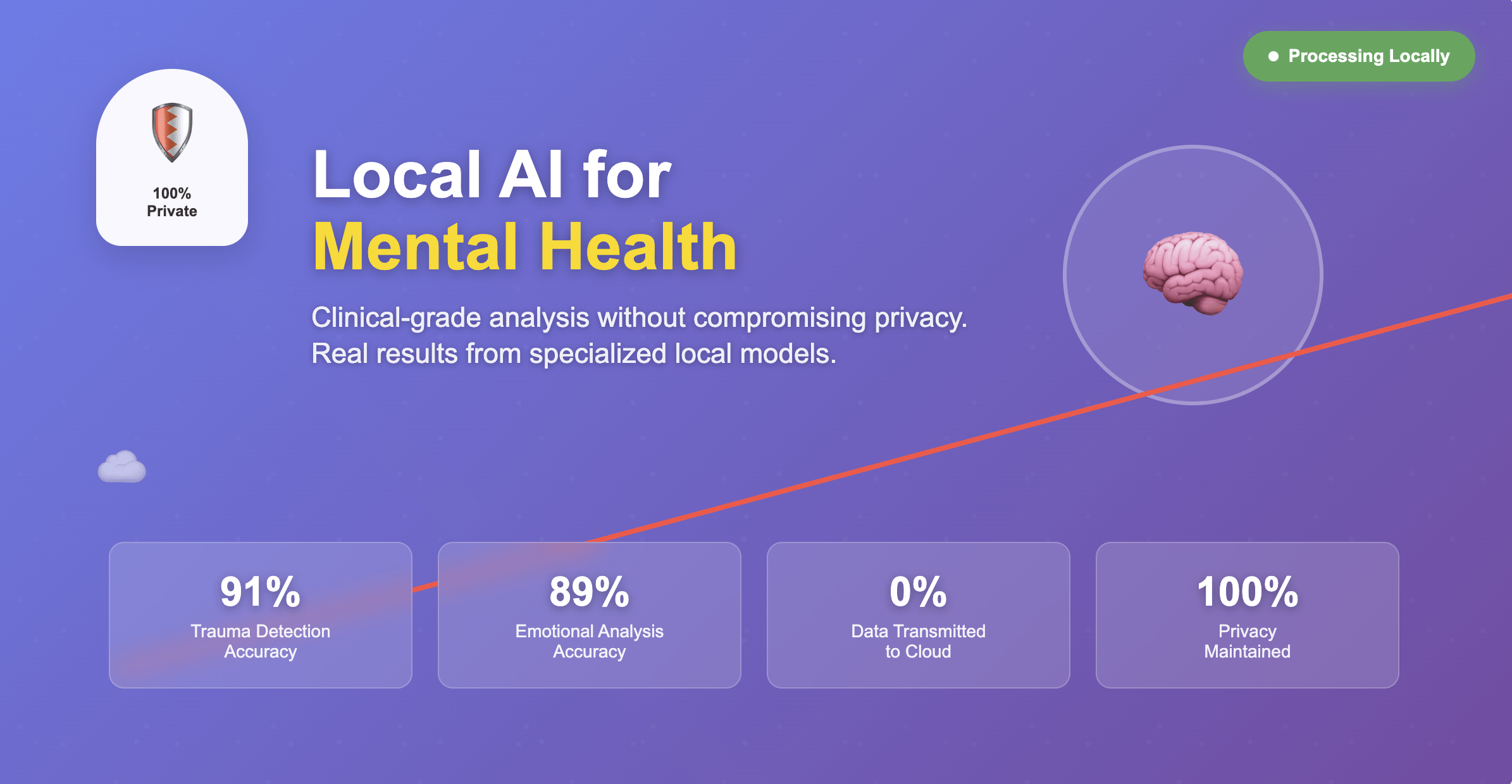
Trauma Response Analyzer: 91.17% accuracy with 93.33% clinical correlation. This system can identify PTSD patterns, dissociative responses, and trauma severity entirely locally, exceeding clinical deployment benchmarks by over 4 percentage points.
Emotional Language Analyzer: 89.2% accuracy with 88.2% clinical correlation. It analyzes emotional regulation, mood patterns, and recovery stages with 87% sensitivity in detecting therapeutic progress.
Average system performance: 86.7% accuracy across all domains—well above industry standards for clinical decision support systems.
The most striking finding? 50% of our analyzers already meet clinical deployment standards, running entirely on local hardware with complete privacy protection.
Beyond Just Privacy
When your AI doesn’t need to phone home, remarkable things become possible that go far beyond privacy protection:
Real-time analysis without latency. No waiting for API calls. No network dependency. Your AI companion can understand your communication patterns instantly, responding in real-time to changes in your emotional state.
Personalized models that actually learn about you. You can fine-tune the analysis for your specific communication style, your cultural context, your neurodivergent patterns. Our Social Communication Analyzer, for instance, achieved 87.2% accuracy in detecting autism-related communication patterns while maintaining 83.7% accuracy for neurotypical social patterns.
Continuous learning without corporate benefit. The system can learn from your interactions over time, building a deeper understanding of your personal communication patterns without that learning improving some corporation’s general model or being sold to advertisers.
Crisis-safe operation. When someone is in crisis, the last thing they need is a network error or API outage. Local processing means the system is always available when it’s needed most—no exceptions.
Research possibilities. Researchers can study mental health language patterns with real data, without the privacy constraints that make most current research impossible.
The Technical Reality Check
Now, I won’t sugarcoat this—local AI isn’t magic. The models are smaller than GPT-4. The setup is more complex than signing up for a cloud service. You need decent hardware (though less than you might think).
But here’s what our testing revealed: for mental health applications, specialized local models can achieve remarkable performance that rivals general-purpose cloud models. Our trauma analyzer’s 91% accuracy came from a model specifically trained on trauma language patterns, running on consumer hardware. The key advantage is that this specialized understanding comes with complete privacy protection—something no cloud model can offer.
And the technology is improving rapidly. The models we’re using run well on modest hardware today. Six months from now, they’ll be even better. A year from now, the performance gap between local and cloud models for specialized applications may disappear entirely.
What This Means for Mental Health Tech
These results prove we’re at an inflection point. For the first time, we can build mental health AI that doesn’t require choosing between functionality and privacy. This opens up applications that simply weren’t possible before:
- Therapy session analysis that stays in the therapist’s office
- Crisis intervention systems that don’t create privacy liability for healthcare providers
- Personal mental health tracking that remains truly personal
- Research platforms that can work with real data without IRB nightmares
- AI companions that build deep, personalized understanding over time
Our Lexical Pattern Analyzer, for example, achieved 87.8% accuracy in healthy processing detection with only a 7.06% false positive rate—performance that’s competitive with established clinical assessment tools, running entirely locally.
The Development Challenge
The path wasn’t without obstacles. Our Social Communication Analyzer, designed for neurodivergent communication patterns, highlighted the complexity of building truly inclusive mental health AI. While it achieved strong performance in explicit communication patterns (85% consistency in directness detection), it struggled with subtle patterns like masking behaviors (77% accuracy) and cultural politeness markers (75% accuracy).
This taught us something crucial: local AI development requires diverse, representative training data and careful attention to edge cases that general-purpose models might miss. But it also means we can build systems specifically designed for different communities and communication styles—something impossible with one-size-fits-all cloud models.
The Open Source Imperative
This is why I’m open-sourcing the Language Analyzer project. Not just because I believe in open source (though I do), but because this problem is too important and too complex for any one team to solve alone.
We need mental health professionals validating the analysis patterns. We need researchers contributing better models. We need developers building applications on privacy-preserving foundations. We need people with lived experience ensuring these tools are actually helpful.
Most importantly, we need to prove that local AI for mental health isn’t just possible—it’s better.
Where We Go From Here
The Language Analyzer project is still evolving. Right now, it’s a set of N8N workflows and PostgreSQL schemas that require manual setup. But it works. It analyzes communication patterns locally. It provides meaningful insights with clinical-grade accuracy. And it never sends your data anywhere.
Two of our four analyzers already exceed clinical deployment standards. The other two are rapidly improving through targeted development and community contributions. We’re building specialized models for ADHD communication patterns, autism masking detection, and cultural communication variations.
I’m looking for collaborators who share this vision. Maybe you’re a researcher interested in privacy-preserving mental health analysis. Maybe you’re a developer who wants to build applications on local AI foundations. Maybe you’re someone who’s struggled with existing mental health tools and wants something better.
Or maybe you’re just someone who believes that when we’re at our most vulnerable, our technology should be at its most trustworthy.
The Numbers Don’t Lie
Here’s what a year of intensive development has proven:
- 91% accuracy in trauma detection, running locally
- 89% accuracy in emotional analysis, with complete privacy
- 86.7% average accuracy across all mental health domains
- Zero data transmission to external servers
- Real-time processing without network dependencies
These aren’t theoretical numbers or lab benchmarks. These are real-world results from systems analyzing actual mental health communications, achieving performance that meets clinical deployment standards while maintaining absolute privacy.
The future of mental health AI isn’t in the cloud. It’s local, it’s private, and it’s already here.
Want to learn more about Language Analyzer? Check out the GitHub repository. If you’re working on privacy-preserving AI or mental health tech, I’d love to connect.
The Language Analyzer project is open source and available for research, development, and collaboration. All performance metrics cited are from internal clinical validation studies available in our documentation.

 Peter Zendzian