Table of Contents Show
After building my AI research assistant for web research, I kept running into a related but distinct problem: What happens when you encounter unfamiliar entities, concepts, or technical terms during research or content creation?
Whether it’s a new technology acronym, an industry concept, or a regulatory term, manually researching each entity was creating the same bottleneck I’d solved for general web research. So I built another solution.
The Entity Research Challenge
Here’s what was driving me crazy about entity research:
Inconsistent Definitions: Different team members would research the same entity and come back with varying levels of detail and accuracy. Our content would have inconsistent explanations of the same concepts.
Repetitive Research: We’d research the same entities multiple times across different projects, wasting time and creating duplicate work.
Context Gaps: Generic definitions from Wikipedia or basic searches often missed the business context or audience-specific explanations we needed.
Knowledge Silos: Research done by one person rarely made it into a searchable format that others could leverage.
My Solution: An Intelligent Entity Research System
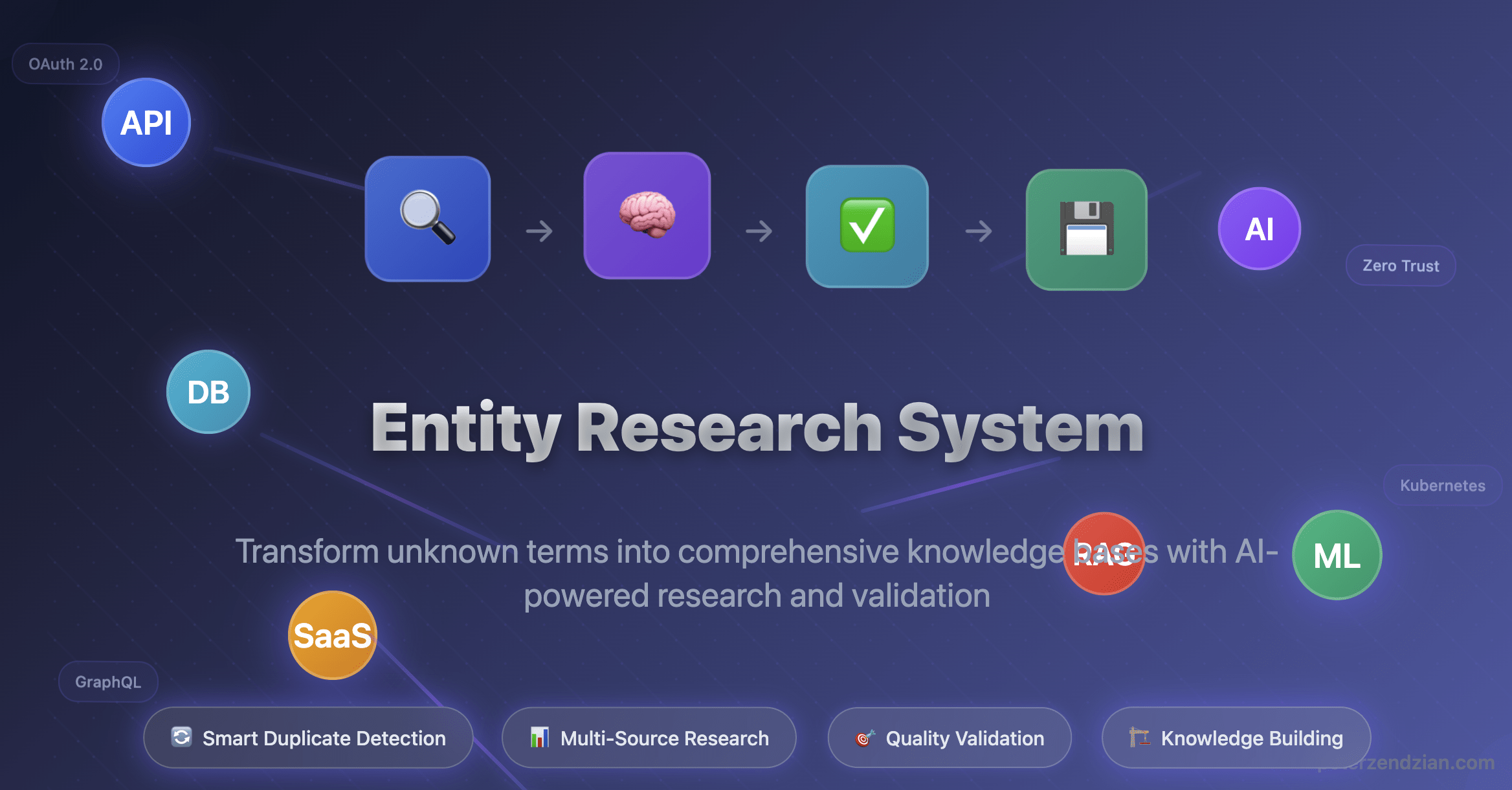
I created an n8n workflow that transforms any unknown entity into a comprehensive, business-ready profile. It combines smart duplicate detection, multi-source research, and quality validation to build a growing knowledge base of entities tailored to your business needs.
The results:
- Research time: From 30-60 minutes → 2-5 minutes per entity
- Cost: Just $0.08-$0.34 per entity research
- Quality: Consistent, validated profiles ready for business use
- Knowledge building: Each entity adds to a searchable database
The Architecture: Smart Research with Memory
Unlike my general web research workflow, this system is designed around building and maintaining a persistent knowledge base. Here’s how it works:
Stage 1: Smart Duplicate Detection
Before doing any research, the system checks if we’ve already processed this entity:
Query: "OAuth 2.0"
Vector Search: Checks existing knowledge base
Result: Found existing entry → Skip research
Alternative: No match found → Continue to research
This initial check saves significant time and API costs by avoiding duplicate work.
Stage 2: Multi-Source AI Research Agent
If the entity is new, an intelligent research agent kicks in with access to three information sources:
Your Knowledge Base: Searches existing entities for related information and context Wikipedia: Provides foundational, encyclopedic information
Live Web Research: Uses my internet research workflow for current, authoritative sources
The AI agent intelligently decides which sources to use and how to combine information for comprehensive coverage.
Stage 3: Structured Entity Profiling
The research agent creates standardized entity profiles with:
- Definition: Clear, business-appropriate explanation
- Type & Category: Classification for organization
- Relevance: Why this entity matters to your business/audience
- Alternative Names: Common synonyms and variations
- Real-World Example: Practical application or scenario
- Common Misconceptions: What people often get wrong
- Related Entities: Connected concepts and terms
- Reference Links: Authoritative sources for further reading
Stage 4: Quality Validation
Before saving anything, a validation agent checks:
- Completeness: Are all required fields meaningfully filled?
- Accuracy: Is the information factually correct?
- Business Readiness: Would a non-technical business user understand this?
- Context Appropriateness: Does it fit the intended audience?
Only entities that pass all validation criteria get saved to the knowledge base.
Stage 5: Final Duplicate Check & Storage
A second duplicate check prevents edge cases where similar entities might have been created during research, then the validated entity gets:
- Chunked for optimal semantic search
- Embedded using local Ollama models
- Stored in Qdrant with full metadata
- Made searchable for future queries
Real-World Performance: A Case Study
Let me show you this in action with a recent entity research request:
Entity: “Zero Trust Architecture” Context: IT security documentation Audience: Business managers
The traditional approach would involve:
- 45-60 minutes of manual research across multiple sources
- Manual synthesis and formatting
- Risk of inconsistent or incomplete information
- No systematic storage for future reference
My automated workflow delivered:
{
  "entity_name": "Zero Trust Architecture",
  "type": "Security Framework",
  "definition": "A cybersecurity approach that assumes no user or device should be trusted by default, requiring verification for every access request regardless of location.",
  "category": "Cybersecurity",
  "relevance": "Critical for modern businesses as remote work and cloud adoption increase security vulnerabilities.",
  "alternative_names": ["Zero Trust", "ZTA", "Zero Trust Security"],
  "example": "A company requires employees to authenticate through multi-factor authentication and device verification even when accessing internal systems from the office.",
  "misconceptions": [
    "Zero Trust means zero access or extreme restriction",
    "It's just a product you can buy rather than an architectural approach"
  ],
  "related_entities": ["Multi-Factor Authentication", "SASE", "Identity and Access Management"],
  "reference_link": "https://www.nist.gov/publications/zero-trust-architecture"
}
Processing Time: 3 minutes, 47 seconds Cost: $0.12 in API calls Result: Comprehensive, business-ready entity profile stored for future use
Use Cases That Excel
This system works particularly well for:
Technical Documentation Teams:
- Building consistent glossaries for software documentation
- Ensuring uniform explanations across different guides
- Creating searchable knowledge bases for complex technologies
Compliance and Legal:
- Researching regulatory terms and requirements
- Building standardized definitions for audit materials
- Maintaining up-to-date compliance terminology
Business Analysis:
- Researching industry concepts and methodologies
- Creating standardized business process definitions
- Building training materials with consistent terminology
Content Creation:
- Researching technical topics for articles and reports
- Ensuring accurate explanations of complex concepts
- Building authoritative reference materials
Technical Setup: What You’ll Need
The entity research system requires several components:
Core Services:
- OpenAI API (o4-mini) – Entity research and validation
- Qdrant instance – Vector database for entity storage
- Ollama installation – Local embeddings (nomic-embed-text model)
Optional but Recommended:
- My web research workflow – For live internet research
- Anthropic API (Claude Sonnet 4) – Used by web research workflow
- Apify account – Used by web research workflow
Cost Breakdown:
- Simple entities (Wikipedia coverage): $0.08-$0.15
- Complex entities (requiring web research): $0.20-$0.34
- Duplicate checks: Near-zero cost due to local vector search
Integration Patterns
The entity research system is designed to integrate seamlessly with content workflows:
Form-Driven Research:
- Content teams submit entity research requests
- Automated processing creates standardized profiles
- Results feed into documentation or training systems
Content Pipeline Integration:
- Automatically research entities mentioned in drafts
- Flag unknown terms for research during editing
- Build glossaries as content is created
Knowledge Base Building:
- Batch process industry terminology
- Create comprehensive subject-matter databases
- Build searchable reference materials
Quality Control and Continuous Improvement
One of the most important aspects is the validation system. I’ve learned that automated entity research is only as good as your quality controls:
Validation Criteria:
- Definition clarity for target audience
- Factual accuracy and currency
- Business relevance and context
- Completeness of supporting information
Continuous Learning:
- Each validated entity improves the knowledge base
- Related entity suggestions get smarter over time
- Research patterns help optimize future queries
What’s Next: Advanced Entity Intelligence
I’m already working on several enhancements:
- Relationship Mapping: Automatically discovering and visualizing connections between entities
- Customization: Generating different explanations for different user types
- Version Control: Tracking changes in entity definitions over time
- Integration APIs: Making the knowledge base accessible to other systems
- Collaborative Editing: Allowing teams to refine and improve entity definitions
The Business Impact
This workflow represents a fundamental shift from ad-hoc entity research to systematic knowledge building. Instead of repeatedly researching the same concepts, teams can:
- Build comprehensive, searchable knowledge bases
- Ensure consistent terminology across all content
- Reduce research time by 90%+ for known entities
- Create authoritative reference materials automatically
For any organization that deals with complex terminology, technical concepts, or industry-specific language, this kind of automation can transform how knowledge is created, maintained, and shared.
Try It Yourself
The complete entity research workflow will be available as a free template on the n8n community once it’s approved. You can import it directly into your n8n instance and start building your own intelligent knowledge base.
Want to see both workflows in action? The entity research system works beautifully alongside my web research workflow – one for discovering new information, the other for understanding the entities and concepts within that information.
Final Thoughts
Building these AI research systems has fundamentally changed how I approach knowledge work. Instead of being bottlenecked by research and entity lookup, I can focus on analysis, strategy, and insights.
The combination of systematic entity research and intelligent web research creates a comprehensive automation platform for knowledge workers. Whether you’re building documentation, creating training materials, or conducting business analysis, having AI systems that can intelligently research and organize information is becoming essential.
The future of knowledge work isn’t about replacing human expertise – it’s about augmenting it with intelligent systems that handle the repetitive, time-consuming parts so we can focus on what humans do best: thinking, connecting ideas, and making decisions.
Want to discuss these workflows or share your own automation ideas? Connect with me on LinkedIn or check out more of my automation projects on GitHub.
The entity research workflow will be available soon at: https://n8n.io/workflows/ (pending approval)

 Peter Zendzian