Table of Contents Show
I’m in my late 50’s and I am still learning not to trust myself when I say “I’ll remember that.”
I might remember how a complex system works. I might remember the shape of a problem, the dependencies, the failure points, and the way all the pieces fit together.
But I may not remember the name of the person I just met.
I may not remember what time it is.
I may not remember the thing I told myself was too obvious to write down.
That mismatch has been part of my life for as long as I can remember. Give me a complex system or a hard problem and I will usually figure it out. I can dig into the machinery, find the weak points, and build a model of how it works.
The problem usually comes after that.
Once the interesting part is solved, the follow-through gets harder. The details get boring. The task loses its shape. Time disappears. The thing I was absolutely going to remember silently falls off the back of the truck.
This is not an intelligence problem. It is not a motivation problem either, even though it can look like one from the outside.
It is a systems problem.
I am not broken, but I do have limits
I do not want to turn this into a long explanation of autism. There are enough of those, and most of them either oversimplify it or turn it into a personality brand.
For me, the useful part is simpler.
I am not broken, but I do have limits.
The harder part is that I do not always know where those limits are. I overestimate what I can keep in my head. I overestimate what I will remember later. I overestimate how reliable future-me will be when the current version of me is busy, tired, bored, or already three steps into another problem.
That is where things go sideways.
I tell myself I will remember something.
I almost never do.
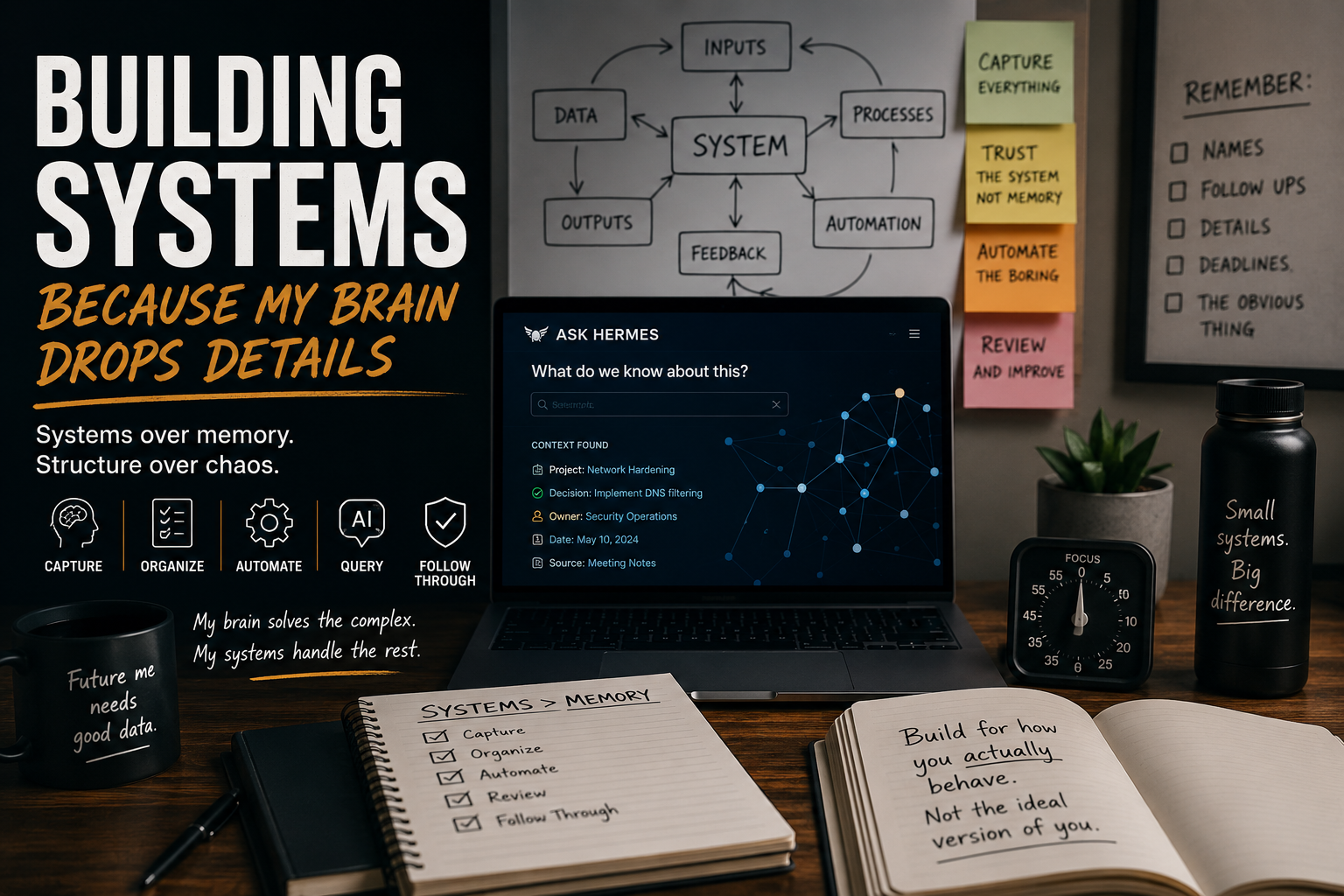
So I have had to build systems outside my head.
Not because systems make me superhuman. They do not. Most days they just stop me from being surprised by the same problem twice, trice or more.
Time is slippery
Time blocking is a good example.
In theory, time blocking should help. Put the work on the calendar. Decide when it happens. Follow the block.
Simple.
Except I will fight the block. Or ignore it. Or lose track of time entirely and realize I have spent three hours on something that was supposed to take twenty minutes.
This is one of the reasons generic productivity advice often misses the point. It assumes the problem is planning. For me, planning is not always the hard part. The hard part is getting the plan to survive contact with my actual brain.
A calendar helps. A reminder helps. A time block helps.
But none of them are magic.
If the system depends on me becoming a perfectly disciplined version of myself next Tuesday, the system will fail. I have met next Tuesday’s version of myself. He is not to be trusted without supervision.
Capturing information is not the same as being able to use it
I use Notion during meetings to collect information. That helps.
The old failure mode was not capturing enough. Something would get discussed, I would assume I had it, and then later I would have a vague memory that something important happened but no useful record of what it was.
Now I can capture more.
That creates a different problem.
There is too much information.
Meeting notes, project notes, customer notes, ideas, tasks, reminders, screenshots, links, messages, documents, emails. It all adds up. Capturing data is easy. Keeping track of it is the hard part.
A pile of notes is not a system.
A pile of notes is a junk drawer with search.
Search helps, but only if I remember what to search for. If I cannot remember the name, phrase, date, project, or context, the information might as well be buried in the yard.
This is why I care so much about systems I can query.
I do not just need a place to store information. I need a way to ask, “What do we know about this?” and get back something useful.
Checklists suck, but they work
I do not naturally love checklists.
They are boring. They slow me down. They feel unnecessary right up until the moment they prevent me from missing something obvious.
That is the annoying thing about checklists. They work.
A checklist is not for the part of me that understands the whole system. It is for the part of me that forgets one small step because I am already thinking about the next three.
This is true in cybersecurity. It is true in business operations. It is true in troubleshooting. It is true in daily life.
The checklist is not there because I do not know what I am doing.
It is there because knowing what I am doing does not guarantee I will remember every step in the right order every time.
That distinction matters.
Automation is not about being fancy
Automation gets treated like a productivity trick.
For me, automation is more basic than that.
Automation is how routine tasks happen when my attention is somewhere else.
If a task is repetitive, boring, easy to forget, and still important, it should probably not depend entirely on my memory. That is asking for trouble.
Automation does not have to be complicated. It can be a scheduled reminder, a recurring task, a form, a workflow, a script, a dashboard, or an AI assistant that knows where to look.
The goal is not to automate everything.
The goal is to remove the tasks that are most likely to get dropped because they are routine, uninteresting, or invisible until they fail.
A good automation is not impressive because it is clever. It is useful because it quietly prevents a known failure mode.
AI memory changes the equation
This is where AI assistants become interesting.
A notebook stores information.
A search box finds words.
An assistant with memory can help recover context.
That is a big difference.
I have been building specialized Hermes agents for different jobs. One of them is helping me write this article. Others are meant to help with research, memory, systems, and the kinds of recurring work that usually turn into loose piles of information.
The value is not that the AI is magic. It is not.
The value is that I can build a source I can query.
I can ask what I said before. I can ask what decisions were made. I can ask what context matters. I can ask it to connect details I would not have connected because the information was spread across too many places.
That matters because the problem is no longer just remembering one thing.
The problem is managing more information than I can reliably hold in my head.
AI memory is powerful because it can turn a pile of captured data into something I can actually use. It can help me find the thread again after I have lost it.
That does not mean trusting it blindly.
Anything important still needs verification. Sources matter. Logs matter. Notes matter. The witness statements matter.
But having a system I can question is different from having a folder full of notes I will never open again.
Build around the real version of yourself
The biggest lesson I keep coming back to is this:
Build systems for how you actually behave, not for the imaginary version of yourself who always follows the plan.
If you ignore time blocks, do not build a life that depends entirely on obeying time blocks.
If you forget names, write them down.
If you lose track of follow-up, capture it during the conversation.
If you hate checklists, make them shorter, but do not pretend you do not need them.
If your notes become a graveyard, build a way to query them.
If boring tasks disappear from your attention, automate them.
There is no moral victory in making life harder than it needs to be.
Systems are tools. They support the parts of us that are inconsistent, overloaded, distracted, or tired.
That does not make them a weakness.
It makes them practical.
What has helped me
Here is the short version of what I have learned.
Stop trusting “I’ll remember that.”
If it matters, capture it somewhere.
Use systems that are easy to query later.
A note you cannot find is mostly decorative.
Automate boring recurring tasks.
Boring tasks are the ones most likely to get dropped.
Use checklists even if you hate them.
A checklist is not a sign that you are dumb. It is a guardrail.
Build around your real behavior.
Do not design systems for some future disciplined version of yourself who has never existed.
Use AI memory carefully.
AI assistants are the most powerful personal tools I have seen, but they still need sources, verification, and boundaries.
Why I am building this way
I am building these systems because my brain drops details.
Not all details. Not all the time. But enough that I have learned not to rely on memory alone.
I can solve complex problems.
I can understand difficult systems.
I can build tools that make work easier.
But I still need support for the ordinary details that make life and business run.
That is why I use notes, checklists, automation, calendars, workflows, and AI assistants.
Not because I want more tools.
I want fewer dropped details.
This article is the foundation for a set of posts I plan to write about the actual systems I am building: how I use Hermes, how I structure AI memory, how I capture meeting notes, and how I decide what should be automated instead of trusted to my attention span.
Because the goal is not to become perfectly organized.
The goal is to build enough structure that important things do not fall on the floor just because my brain moved on to something more interesting.


 Peter Zendzian